
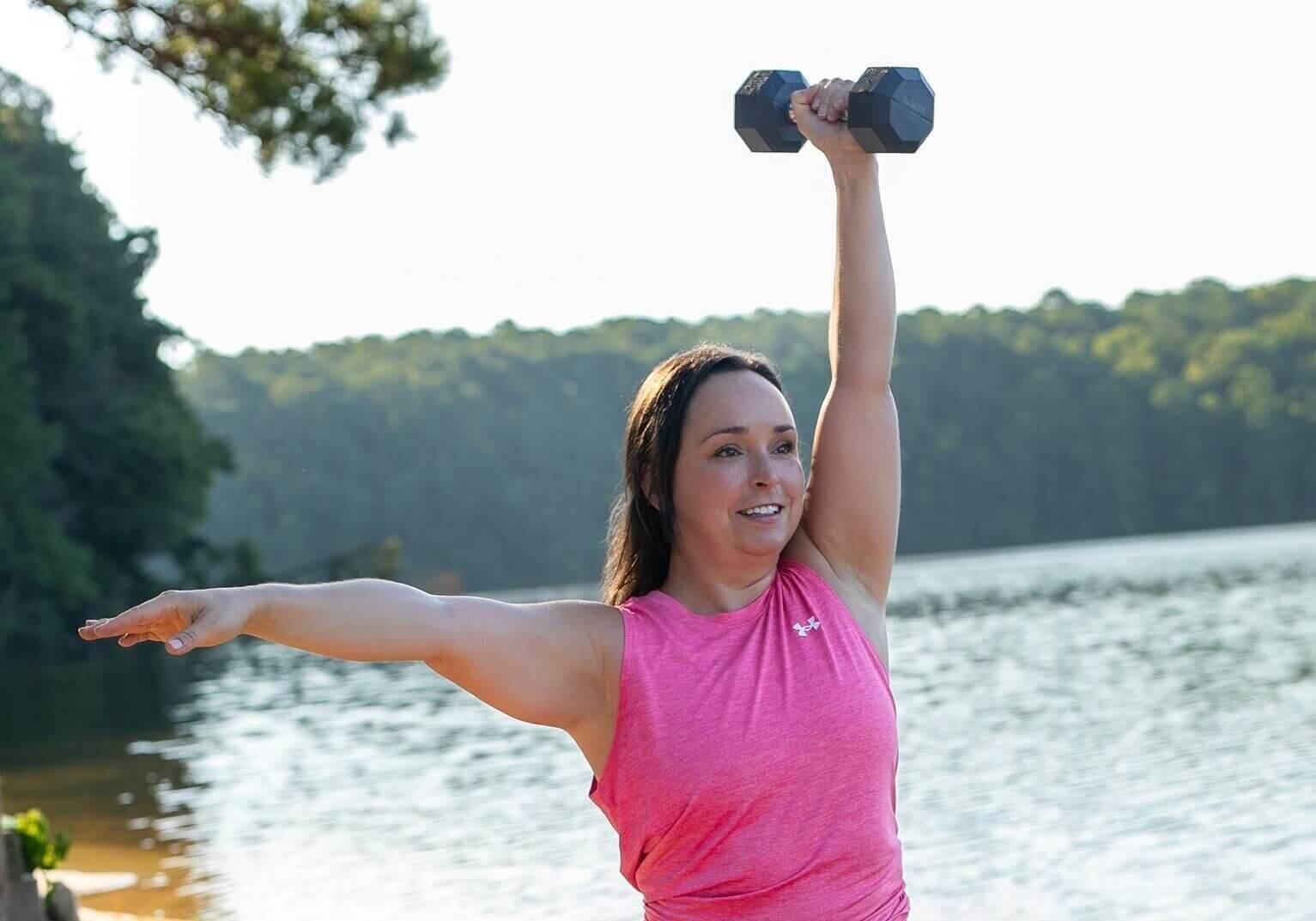
You Don’t Need to Get Smaller. You Need to Get Stronger.
The goal you were sold
For as long as most of us can remember, the goal was “smaller.” Every January the industry handed us a new plan to get there. Every spring we quietly started over. You weren’t failing. You were sold the wrong goal.
So let’s unlearn it. The goal was never small, the goal is strong, and the research has been saying so for years.
What the research actually says
Muscle is something you keep, or slowly lose
As we get older, women lose about 3.7% of their muscle per decade. Strength drops even faster, 2 to 5 times faster than muscle itself. The researchers behind that review put it plainly: losing strength is a more consistent risk for disability and death than losing muscle size. (Mitchell et al., 2012) They’re connected, but they’re not the same thing. Strength also depends on how well your brain and nerves fire your muscles, and training builds both.
Skinny is the industry’s moneymaker, and the magic pill keeps us buying. We’re not falling for it anymore. Your strength is what carries the groceries, gets you up off the floor, and keeps you independent.
Strength is linked to a longer, healthier life
A review of 16 studies found that adults who did muscle-strengthening activities had a 10 to 17% lower risk of dying from any cause. They also had lower risk of heart disease, cancer, and diabetes. The biggest benefit showed up at about 30 to 60 minutes a week. (Momma et al., 2022)
Read that again: 30 to 60 minutes. A week. Not hours a day.
Strong bones are built, not protected
We’ve been told to go gentle on our bodies as we age. In the LIFTMOR trial, 101 postmenopausal women with low bone density (average age 65) lifted heavy twice a week, 30 minutes at a time, for 8 months. Their spine bone density went up 2.9%, while the gentle home-program group went down 1.2%. Every physical function test improved too. (Watson et al., 2018)
One important note: those women trained with supervision. Heavy lifting is for building up to with good coaching, not for jumping into alone.
Strength keeps you on your feet
1 in 4 adults 65 and older reports a fall every year, and falls are the leading cause of injury in that age group. The CDC also calls them preventable. (CDC) Strong legs and good balance are a big part of how we prevent them.
What this means for you: back to basics
The truth is simpler than they told you. Here’s what the guidelines ask of adults 65 and older. Don’t wait until then. The strength you build now is what carries you to 65 and beyond. (CDC)
- Build strength 2 days a week. Work all the major muscle groups: legs, hips, back, chest, shoulders, arms, and core. You can use dumbbells, bands, or your body weight.
- Move every day. Aim for 150 to 300 minutes a week of moderate physical activity. That’s about 30 to 45 minutes most days, and more is even better.
- Practice balance. Stand on one foot while you brush your teeth. Walk heel to toe down the hallway. Small, daily, and it adds up.
- Fuel your muscles. Experts agree we need more protein as we get older to keep muscle and stay strong. (PROT-AGE Study Group, 2013) My simple rule: a palm-sized portion of protein at every meal, built from real whole foods.
- Start where you are. If you have a health condition or haven’t been active in a while, check in with your doctor first, then build up slowly. Consistency becomes habit. Habit becomes lifestyle.
No shrinking. No starting over every Monday. Just the basics, done often enough that they stick.
Strong, not small
You don’t need to get smaller. You need to get stronger, so you can carry your own groceries, lift your grandkids, travel, and get up off the floor without thinking twice. That’s not a phase. That’s for life.
Want a simple place to start? My free 21-Day Feel Fit Fast program gives you exactly what to do each day, no guesswork. Get it free here.
Get strong. Stay moving.
Coach Lil
Sources
- Mitchell WK, Williams J, Atherton P, Larvin M, Lund J, Narici M. Sarcopenia, dynapenia, and the impact of advancing age on human skeletal muscle size and strength; a quantitative review. Frontiers in Physiology, 2012;3:260.
- Momma H, Kawakami R, Honda T, Sawada SS. Muscle-strengthening activities are associated with lower risk and mortality in major non-communicable diseases: a systematic review and meta-analysis of cohort studies. British Journal of Sports Medicine, 2022;56(13):755-763.
- Watson SL, Weeks BK, Weis LJ, Harding AT, Horan SA, Beck BR. High-Intensity Resistance and Impact Training Improves Bone Mineral Density and Physical Function in Postmenopausal Women With Osteopenia and Osteoporosis: The LIFTMOR Randomized Controlled Trial. Journal of Bone and Mineral Research, 2018;33(2):211-220.
- Centers for Disease Control and Prevention. Older Adult Falls Data.
- Centers for Disease Control and Prevention. Physical Activity Guidelines for Older Adults, based on the Physical Activity Guidelines for Americans, 2nd edition (2018). See also ODPHP, Top 10 Things to Know About the Second Edition of the Physical Activity Guidelines for Americans.
- Bauer J, et al. Evidence-based recommendations for optimal dietary protein intake in older people: a position paper from the PROT-AGE Study Group. Journal of the American Medical Directors Association, 2013;14(8):542-559.
This post is for education only and isn’t medical advice. Talk with your doctor before starting a new physical activity routine, especially if you have a health condition.
